A Practical Workflow for Parallel Coding Agents
Parallel execution is easy. Preserving independent evidence and a reviewable path to main is the real system.
Contents
- Start with a task graph, not a list of prompts
- Give every editable task a physical boundary
- Write prompts that produce reviewable outcomes
- Put durable context in the repository
- Prepare the workspace before inference begins
- Dispatch by task shape, not brand loyalty
- Monitor state transitions, not every token
- Verification is a separate phase
- Merge in dependency order
- Use a concurrency budget
- A repeatable Agentastic loop
- Related guides
- Frequently asked questions
A reliable parallel coding-agent workflow has seven stages: decompose the work, choose dependencies, isolate each task, prepare its environment, dispatch the right agent, verify the result, and merge in dependency order. Running several terminals is only the execution stage.
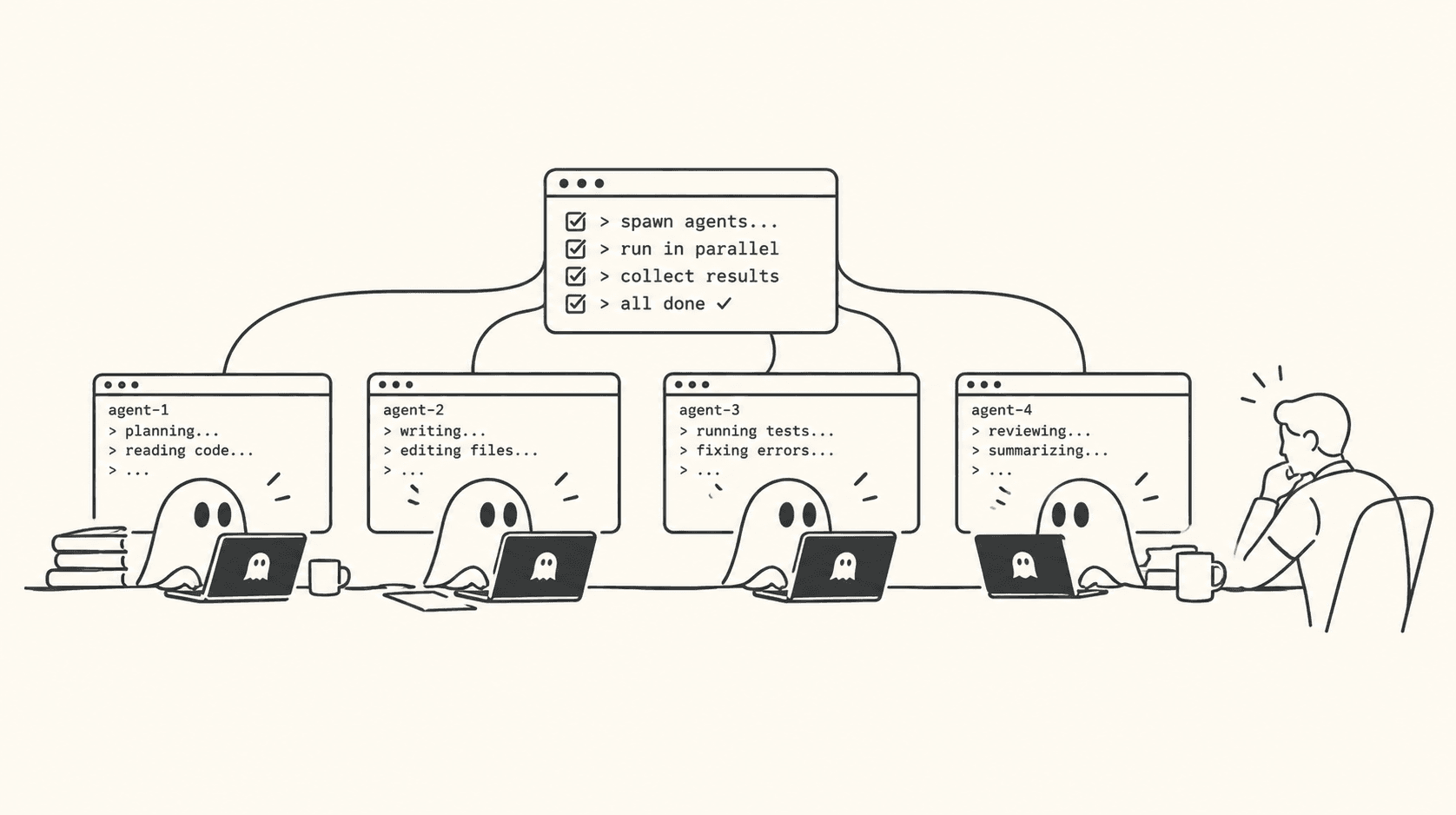
This guide is provider-agnostic. The workers can be Claude Code, Codex, Gemini CLI, Cursor, OpenCode, or any mix that fits the tasks. For the concepts and patterns behind it, see our guide to agent orchestration for software development.
Start with a task graph, not a list of prompts#
Before launching anything, classify the work:
- Independent: can merge in any order.
- Dependent: needs the output of another task.
- Competing: several agents attempt the same outcome and only one result survives.
- Shared-state: touches the same schema, generated file, service, or central interface.
Only independent and intentionally competing tasks should start together by default.
Suppose a feature needs an API endpoint, a React screen, database changes, and end-to-end tests. Launching all four at once sounds fast, but the UI and tests depend on the final API and schema. A safer plan is:
- Schema and API contract.
- API implementation after the contract is accepted.
- UI and test work in parallel against that accepted contract.
- Integration review after both branches land.
The goal is not maximum simultaneous agents. It is minimum idle time without creating speculative work that must be rewritten.
Give every editable task a physical boundary#
Two agents should not edit the same working directory. Use one of these boundaries:
| Boundary | Isolates | Best for |
|---|---|---|
| Git worktree | Repository files, untracked files, local build output | Normal features, fixes, tests, docs |
| Container-backed worktree | Files plus processes, packages, mounts, and network policy | Dependency changes, service-heavy work, untrusted tooling |
| Remote or cloud workspace | Execution host and lifecycle | Long-running tasks, more compute, work that must survive laptop sleep |
Git's worktree documentation describes the underlying model, and our git worktree cheat sheet covers the everyday commands. Agentastic creates and tracks these environments automatically, but the branches remain ordinary Git branches.
Write prompts that produce reviewable outcomes#
Every task prompt should include five things:
- Outcome: what should be true when finished.
- Scope: where the agent may work.
- Constraints: behavior or APIs that must not change.
- Verification: commands or evidence required.
- Handoff: what the final summary must contain.
For example:
Add server-side validation for checkout coupon codes.

Scope: packages/api/src/checkout and its focused tests.
Do not change the public response schema or the existing retry behavior.
Run `pnpm test checkout-coupon` and include the exact result.
Finish with the root cause, files changed, and any behavior you could not verify.
The agent should not decide what "done" means after it has already chosen an implementation.
Put durable context in the repository#
Prompts are task context. Repository conventions belong in versioned instruction files:
AGENTS.mdfor cross-agent repository rules.- Feature-level
AGENTS.mdfiles for module-specific rules. - Tests and scripts as executable expectations.
- Architecture decision records for durable reasoning.
.agentastic/setup.shfor environment preparation.
This keeps Claude Code, Codex, and other agents aligned without copying a long preamble into every task.
Prepare the workspace before inference begins#
The best prompt cannot compensate for a checkout that cannot run the project. A new workspace may need:
- Dependencies.
- Ignored environment files.
- Generated code.
- A virtual environment.
- A unique database or schema.
- A non-conflicting port.
- Local emulators or containers.
Agentastic runs .agentastic/setup.sh when it creates a worktree. Keep the script deterministic and idempotent. See environment setup for agent worktrees for a complete example.
Dispatch by task shape, not brand loyalty#
Different agents and interfaces are useful for different work:
- Use the provider you trust for a difficult implementation.
- Use a fast agent for narrow mechanical changes.
- Use a separate model or dedicated reviewer for the final diff.
- Race two agents only when the quality gain is worth reviewing two implementations.
- Prefer container or remote execution when the task needs an environment, not merely a different model.
Agentastic keeps the execution layer separate from the provider. You can run Claude Code on one branch, Codex on another, and a dedicated review agent after both finish.
Monitor state transitions, not every token#
Watching five transcripts does not scale. A useful control surface answers:
- Which tasks are still running?
- Which agent is waiting for approval or clarification?
- Which task failed setup or execution?
- Which branches have changes ready for review?
- Which pull requests are open or merged?
Agentastic routes supported provider lifecycle events into the Agents navigator and notification inbox. The terminal remains available when you need detail, but supervision happens by exception.
Verification is a separate phase#
An agent's final message is a claim. Verification is the evidence.
For each worktree:
- Inspect the diff.
- Check the task stayed within scope.
- Run the focused test command.
- Start the application from that worktree.
- Exercise the changed behavior.
- Review migrations, permissions, generated files, and dependency changes separately.
- Ask a fresh reviewer to look for bugs the implementer normalized away.
For browser-facing work, the built-in browser gives the agent and reviewer the same page, console, screenshot, and DOM snapshot. A green unit test is not enough when the change is visual or interactive.
Merge in dependency order#
Independent branches can merge in any order. Dependent branches cannot.
After an upstream branch lands:
- Update dependent worktrees.
- Rerun their validation against the new base.
- Resolve conflicts in the branch that owns the dependent change.
- Do not accept a previously green result if its assumptions changed.
Keep each branch pull-request sized. A massive parallel diff is still a massive diff.
Use a concurrency budget#
The useful upper bound is set by review, not compute. Track three queues:
- Agents actively working.
- Agents waiting for you.
- Diffs waiting for review.
If the review queue grows every hour, lower concurrency. If agents are idle because tasks depend on an unfinished contract, improve decomposition. If most sessions wait on environment problems, fix setup before buying more parallelism.
A repeatable Agentastic loop#
- Open a repository.
- Write or update
AGENTS.mdand.agentastic/setup.sh. - Split the work into independent and dependent tasks.
- Launch one isolated workspace per ready task.
- Respond only when an agent needs attention.
- Verify the result in its own worktree.
- Run an independent review.
- Merge in dependency order.
- Archive or remove completed worktrees.
- Record any repeated failure as a repository instruction, test, or setup improvement.
That last step is the compounding part. Every failure you convert into automation makes the next agent cheaper to supervise.
Download Agentastic for macOS or continue with Multi-Agent Programming.
Related guides#
- Run multiple Claude Code agents in parallel
- Run multiple Codex agents in parallel
- Git worktrees for AI coding agents
- Code Review
Frequently asked questions#
How do you run AI coding agents in parallel safely?#
Treat running agents as one stage of seven: decompose the work, choose dependencies, isolate each task, prepare its environment, dispatch the right agent, verify the result, and merge in dependency order. Give every editable task its own worktree, container, or remote workspace.
Which coding tasks should run in parallel?#
Independent tasks that can merge in any order, and intentionally competing attempts where only one result survives. Sequence dependent work and anything that shares a schema, generated file, service, or central interface.
How many coding agents should I run at once?#
Let review capacity set the limit, not compute. Track three queues: agents working, agents waiting for you, and diffs waiting for review. If the review queue grows every hour, lower concurrency.
What should a prompt for a parallel coding agent include?#
Five things: the outcome, the scope the agent may work in, the constraints it must not break, the verification commands or evidence required, and what its final summary must contain.
Should I use git worktrees or containers for parallel agents?#
Use a worktree for normal features, fixes, tests, and docs. Use a container-backed worktree when processes, packages, mounts, or network access need a boundary, and a remote or cloud workspace for long runs that must survive your laptop sleeping.
How do I merge work from several coding agents?#
Merge in dependency order. After an upstream branch lands, update the dependent worktrees, rerun their validation against the new base, and resolve conflicts in the branch that owns the dependent change.